Maintaining Quality with a Small Team: Lessons from a Michelin-Starred Restaurant
Corporate dinners and events call for more than good food. They require the ability to maintain a consistent standard within limited time and particular conditions: keeping to the programme, preserving the temperature and flow of the dishes, and making the right decisions as circumstances change.
I learned much of that foundation during my second year of training in France, at a restaurant that held one Michelin star at the time.
With a Small Team, Preparation Matters Even More
The kitchen team consisted of me and one young French colleague. Between the two of us, we cooked for around 40 guests. I had never previously worked a service with such a small team, and at first I found it disorientating.
There were seven or eight choices for the main course alone, all of which had to be finished with very few hands. How far should we prepare in advance? What should wait until an order came in? In what sequence should we cook, add the sauces and plate the dishes?
In a small kitchen, weak organisation immediately becomes a delay or inconsistency on the plate. We needed the ability to make the whole service work, as well as the ability to cook.
The Menu Begins with the Day’s Ingredients
The owner-chef did almost everything himself. He bought the ingredients, wrote the menu, cleaned the dining room and laid the tables before service. Afterwards, he attended to the garden and his family. Even now, I remember how extraordinarily hard he worked.
The way the menu changed made a particular impression on me. An ingredient would remain on the menu until it was used up. New ingredients would then arrive and the menu would change immediately.
One morning after a day off, I found crayfish and quail that the chef had bought. As I wondered how we would use them, at around eleven, just before service, he announced, “The menu is ready.” It included both the quail and the crayfish—as starters we would need to serve almost at once.
We moved straight from preparing the ingredients into service. Seeing what had arrived, thinking, organising and making it work as a dish demanded real judgement from a cook.
Food Cooked to Order Has a Particular Energy
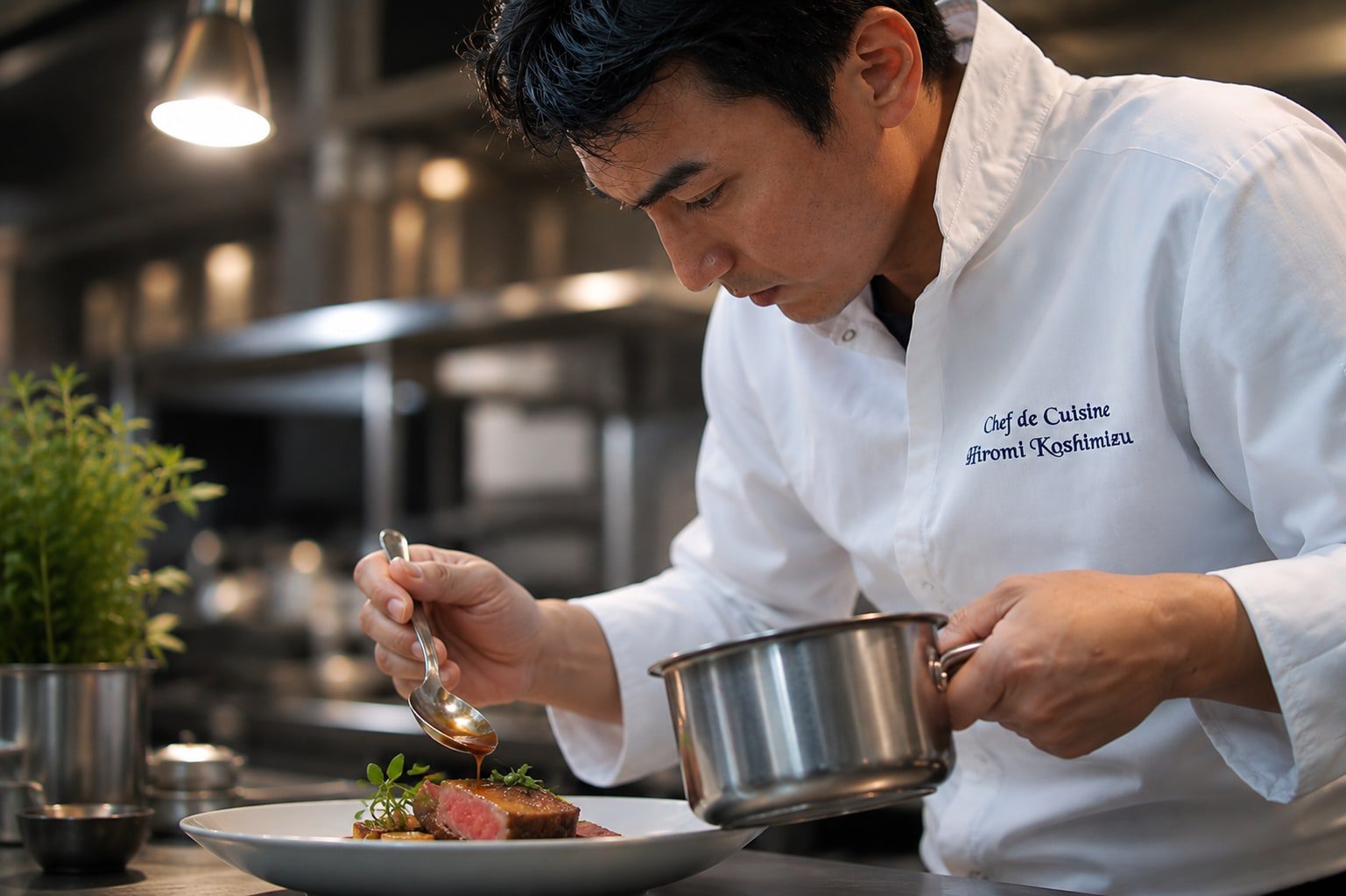
That experience taught me the pleasure of cooking à la minute: buying good ingredients, preparing them promptly and cooking them immediately. Heat, sauce and plating come together at the moment they are needed. The result has an energy that food held in advance cannot reproduce.
The region was also known for its poultry, and the restaurant had a poultry speciality. The possibilities of the ingredient, the way we made stocks, the approach to sauces and the precision of cooking all became foundations for my own food.
The Skills of Running a Service Remain with Me
As I became more accustomed to life in France, I began visiting markets and buying ingredients on my days off. Once I bought a whole case of eggs and practised making omelettes. I also repeatedly practised turning vegetables into uniform shapes.
These were not spectacular experiences. But repetition of the fundamentals builds a cook’s capacity for the work.
Those lessons remain important whenever Hiromi Koshimizu Gastronomie undertakes a corporate dinner or catering assignment. Every setting has constraints: the equipment, serving times, guest numbers, programme and host’s intentions.
Within those conditions, how should the food be prepared, how should the service flow, and where are decisions needed? The work is about providing food and ensuring that the whole occasion proceeds with confidence.
Maintaining quality with a small team. Finding the best approach within limited conditions. Making calm decisions when something unexpected happens. The practical judgement I developed at that Michelin-starred restaurant in my second year in France remains a foundation of my work.